
Transparent Emission Schedules: Building Trust in Crypto Tokenomics
 Nov, 15 2026
Imagine buying a house where the seller refuses to tell you when the next ten neighbors will move in. You know they exist, but you don't know if they’ll park their cars on your lawn or block your driveway. That uncertainty is exactly what opaque crypto emission schedules create for investors. In the early days of blockchain, vague promises about supply were tolerated. Today, with over 1,021 projects tracked by analytics platforms as of late 2026, that ambiguity is a dealbreaker. If you can’t see exactly when tokens hit the market, you’re gambling blind.
Transparent emission schedules are detailed, time-based models that publish exactly how many tokens enter circulation, on which dates, and to whom. Unlike the old model of "trust us," these schedules are enforced on-chain and verifiable by anyone. The shift isn't just cultural; it’s regulatory. Under the EU’s Markets in Crypto-Assets Regulation, known as MiCA, whitepapers must now explicitly disclose quantity, emission rules, and vesting details. This convergence of regulation and investor demand has made supply transparency the single strongest determinant of trust in digital assets.
The Mechanics of Supply: Emission vs. Vesting
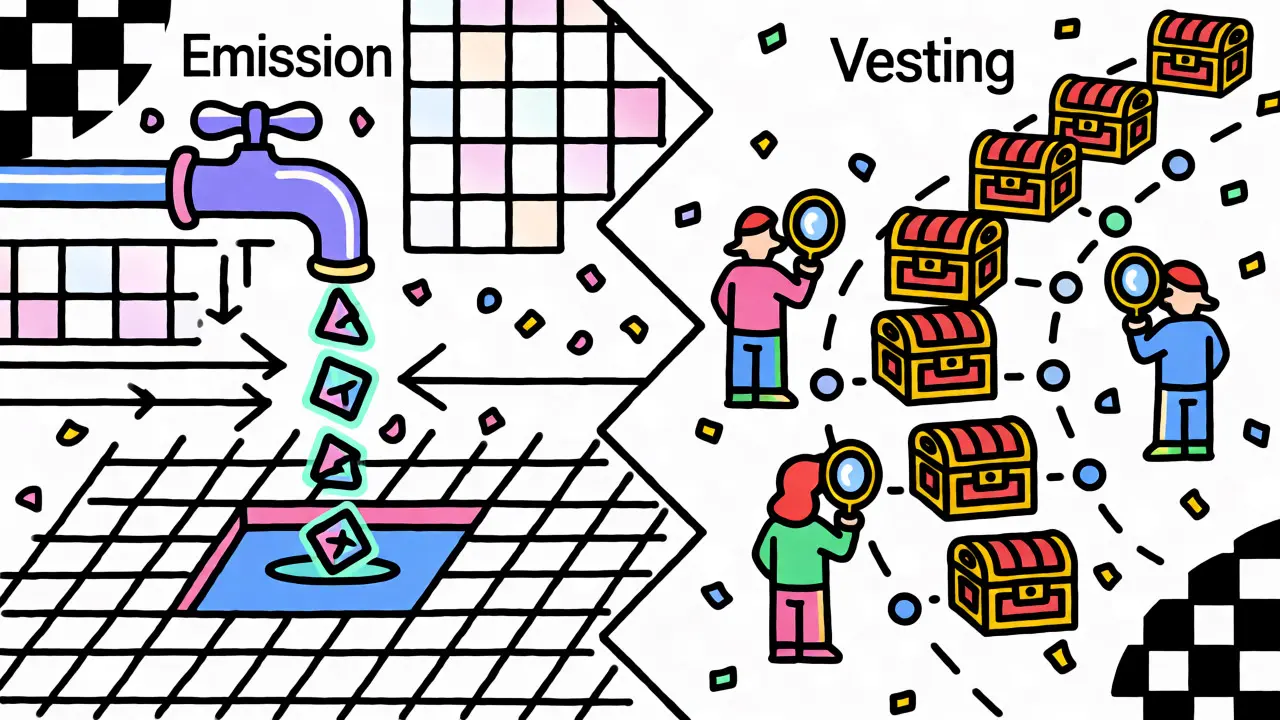
Before diving into trust, let’s clear up the jargon. Many people use "emission" and "vesting" interchangeably, but they do different jobs. An emission schedule answers one question: how much new supply hits the market? This could be through protocol inflation, staking rewards, or liquidity mining. Think of it as the faucet turning on. For example, some protocols mint a fixed number of tokens per block, while others use complex epoch-based releases, like releasing rewards every 14 days for seven years.
Vesting schedules, on the other hand, control existing supply. They dictate when locked tokens-held by teams, early investors, or foundations-are allowed to sell. A standard vesting contract includes three key parameters: the cliff (a waiting period before any release), the duration (how long the release takes), and the cadence (monthly, quarterly, etc.). If a project hides its vesting terms, you have no idea if insiders are dumping their bags next month. Transparency means publishing these exact numbers before the token ever trades.
Why Transparency Builds Investor Confidence
Does clarity actually make money? The data says yes. A 2025 study of 458 U.S. investors found that 78% prioritized CEO and platform transparency as a key investment criterion. More specifically, respondents noted that detailed disclosures about token supply schedules and vesting timelines directly reduced their anxiety and increased trading volumes. When investors can calculate future dilution, they price risk accurately rather than reacting in panic.
Consider the alternative: an opaque schedule. If a large team allocation unlocks unexpectedly, sell pressure spikes, crashing the price. Investors who didn't know this was coming feel betrayed. Research published in journals like IJFMR identifies platform transparency as the top driver of trust in crypto. It’s not just about fairness; it’s about predictability. When you know a project will release 5% of its supply in Q3, you can hedge or adjust your strategy. When you don’t know, you’re at the mercy of insider discretion.
Regulatory Standards: The MiCA Effect
Since 2023, the bar for entry has risen sharply. The EU’s MiCA framework mandates that every whitepaper include a dated table showing month-by-month emissions. This isn't optional fluff; it's legal compliance. Issuers must specify whether supply is fixed or elastic, and if elastic, what governance mechanisms allow changes. This standardized format allows analysts to compare projects side-by-side without digging through forum posts or guessing from blog updates.
Best practice now involves more than just prose. Leading projects provide machine-readable artifacts, such as CSV files and SVG charts, alongside their narrative explanations. This lets developers and quants plug the data directly into models. If a project only offers a vague paragraph saying "team tokens vest over four years," it fails the modern diligence test. You need the start date, the cliff length, and the exact percentage released each month.
Case Study: Orderly Network’s Epoch Model
To see transparency in action, look at Orderly Network. Its tokenomics page doesn't just guess; it calculates. It specifies that trading rewards for the ORDER token unlock over 200 epochs, with each epoch lasting 14 days. That’s a precise seven-year horizon. It also discloses that 13.3% of the maximum supply (133 million tokens) unlocked at the Token Generation Event (TGE) for retroactive rewards.
This level of detail allows users to forecast circulating supply growth in two-week increments. Furthermore, Orderly notes that market-making rewards unlock linearly at 500,000 ORDER per epoch. By linking these numbers to audited smart contracts, they remove the possibility of hidden mints. Compare this to older projects where "community funds" were a black box, and you see why modern investors prefer the former. The latter forces you to trust; the former lets you verify.
How to Verify On-Chain Truth
Paperwork lies; code doesn’t. The ultimate test of a transparent schedule is on-chain verification. Tools like UNCX Network and others allow anyone to query vesting contracts directly. If a whitepaper says team tokens unlock monthly after a one-year cliff, the smart contract must enforce exactly that. Any mismatch between the documentation and the contract logic is a red flag.
Here is a simple checklist for due diligence:
- Check the Contract Address: Is the vesting contract address public? Can you view it on a block explorer?
- Compare Tables: Do the dates in the whitepaper match the timestamps in the contract?
- Look for Governance Risks: Does the DAO have the power to change emission rates arbitrarily? If so, is there a timelock?
- Cross-Reference Analytics: Use platforms like Tokenomist or CryptoRank to see if third-party trackers agree with the project’s claims.

Common Pitfalls in Emission Design
Transparency alone isn't enough; the design matters too. A common mistake is naive linear unlocking. If a project releases large chunks of supply into a thin market with low utility demand, the price often suffers. Experts like Colin Dijs argue that emission shapes should align with usage growth. For instance, emitting more tokens when network activity is high creates better value accrual than a flat rate regardless of adoption.
Another pitfall is the "revocable" clause. Some team allocations are revocable if employees leave early, while investor allocations are irrevocable. If this distinction isn't clear, investors might worry about insider manipulation. Always ask: who controls the keys to the treasury? If the answer is "the core team via a multisig," ensure that multisig policy is documented.
The Future of Supply Communication
We are moving toward a world where transparent emission communication is baseline, not a bonus. As institutional capital enters crypto, the tolerance for ambiguity shrinks. Projects that fail to adopt standardized disclosure formats risk exclusion from regulated venues and skepticism from data-literate retail traders. The trend is toward non-linear, milestone-based emissions that are still fully visible. Imagine a protocol that emits tokens only when TVL exceeds certain thresholds, all coded into a verifiable oracle system.
For now, stick to the rule: if you can’t find a detailed, dated, and on-chain-verifiable emission schedule, treat the project as high-risk. Trust is earned through visibility, not marketing slogans.
| Feature | Transparent Schedule | Opaque Schedule |
|---|---|---|
| Data Availability | Detailed tables, CSVs, and charts available pre-TGE. | Vague statements or missing data points. |
| Verification | On-chain smart contracts match documentation exactly. | No public contract or mismatch between docs and code. |
| Investor Behavior | Higher confidence; predictable dilution pricing. | High volatility; fear of unexpected dumps. |
| Regulatory Status | Compliant with MiCA Article 6 disclosure requirements. | At risk of non-compliance in EU markets. |
| Trust Level | High; reduces information asymmetry. | Low; relies on blind faith in leadership. |
What is the difference between emission and vesting?
Emission refers to the creation of new tokens entering circulation, typically through protocol rewards or inflation. Vesting refers to the gradual release of existing, locked tokens (like those held by teams or investors) according to a predefined schedule. Emission adds new supply; vesting unlocks previously reserved supply.
Why is MiCA important for crypto tokenomics?
The Markets in Crypto-Assets (MiCA) regulation in the EU mandates strict disclosure standards. It requires issuers to publish detailed supply schedules, including total quantity, creation/destruction mechanisms, and specific vesting conditions in their whitepapers. This forces projects to be transparent, reducing fraud and aiding investor comparison.
Can emission schedules be changed after launch?
Yes, but transparency requires disclosing how they can be changed. Often, this is governed by a Decentralized Autonomous Organization (DAO). Best practice involves a timelock, allowing investors to see proposed changes before they take effect, ensuring no sudden, surprise alterations to supply dynamics.
Where can I find token unlock calendars?
Platforms like Tokenomist, CryptoRank, DropsTab, and CoinGecko track unlock schedules for thousands of projects. These tools aggregate data from whitepapers and on-chain contracts, providing visual calendars that show upcoming unlock dates, sizes, and recipient groups.
Is a longer vesting period always better?
Not necessarily. While longer vesting prevents immediate dumping, it can reduce liquidity and discourage early participation if incentives aren't aligned. The ideal schedule balances retention (keeping team members committed) with liquidity (allowing reasonable exits). Cliffs and step-wise releases are often used to manage this balance.