
Treasury Diversification Strategies: Balancing Risk and Yield in 2026
 Jul, 20 2026
For decades, the financial world operated on a simple rule: when stocks crash, government bonds save you. That reliable negative correlation between equities and U.S. Treasuries made the classic 60/40 portfolio (60% stocks, 40% bonds) the gold standard for retirement planning. But as we move through mid-2026, that safety net is fraying. Inflation spikes, massive fiscal deficits, and shifting global dynamics have weakened the traditional hedge. Today, simply buying "Treasuries" isn't enough. To protect your wealth while still generating meaningful income, you need a sophisticated approach to treasury diversification. This means moving beyond a single maturity or issuer to build a resilient fixed-income sleeve that balances capital preservation with yield generation.
The Core Components of Treasury Diversification
Treasury diversification isn't just about holding more bonds; it's about holding the *right* mix of sovereign debt instruments to manage specific risks. At its heart, this strategy involves blending different types of government-backed securities to offset one another’s weaknesses. The primary entities here are standard U.S. Treasuries, Treasury Inflation-Protected Securities (TIPS), and STRIPS (Separate Trading of Registered Interest and Principal of Securities).
Standard U.S. Treasuries offer near-zero default risk and deep liquidity, with daily trading volumes often exceeding hundreds of billions of dollars. However, they carry interest rate risk-if rates rise, their prices fall. TIPS address a different threat: inflation. By adjusting the principal value based on the Consumer Price Index (CPI), TIPS protect your purchasing power, though they may underperform in deflationary environments. STRIPS take this further by stripping coupons from zero-coupon bonds, creating highly sensitive instruments for managing duration and cash flow timing. A robust diversification strategy doesn't pick one winner; it allocates across these three pillars to mitigate reinvestment, inflation, and interest-rate risks simultaneously.
Managing Duration: The Laddering Strategy
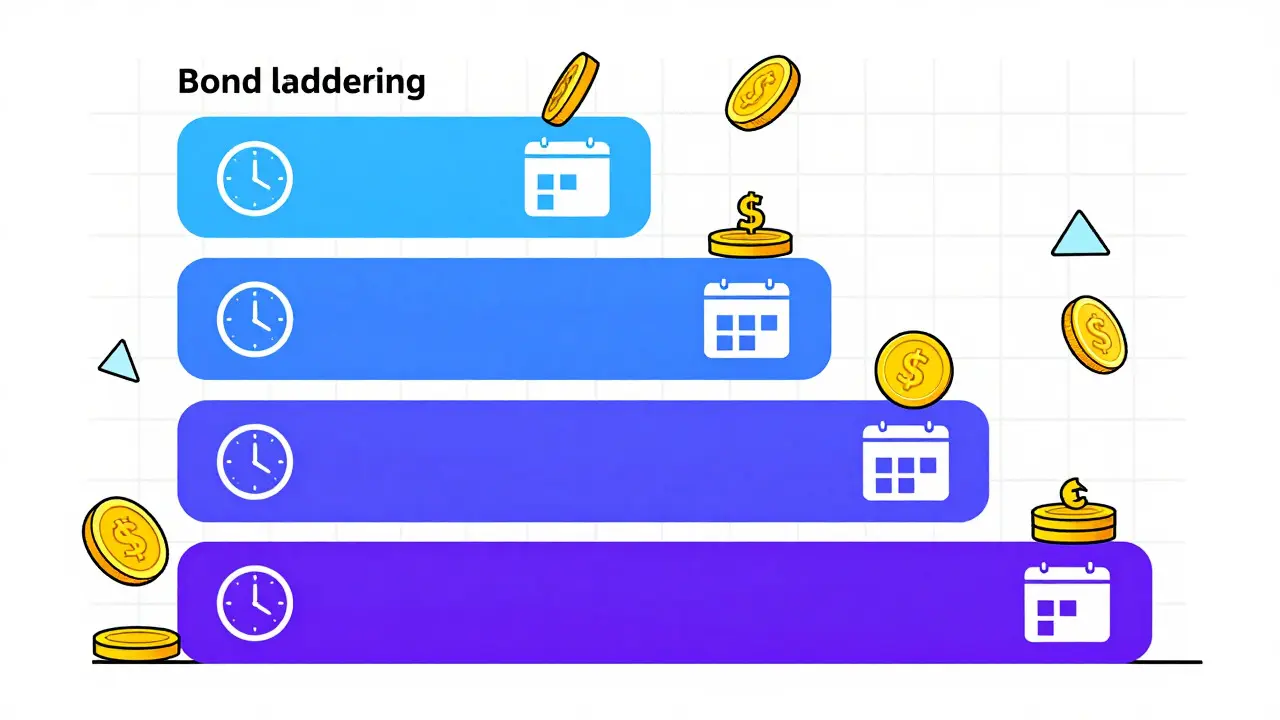
One of the most effective ways to implement treasury diversification is through bond laddering. This technique spreads your investments across various maturities, such as annually over a 5-to-10-year period. Why does this matter? Because it reduces both reinvestment risk and market-timing risk. If you buy only long-term bonds and rates drop, you’re stuck with lower yields. If you buy only short-term bonds and rates rise, you miss out on locking in higher returns early.
Consider a practical example: An investor divides $100,000 into five equal tranches, buying 1-year, 2-year, 3-year, 4-year, and 5-year Treasuries. As each bond matures, the principal is reinvested at the current market rate for a new 5-year term. This creates a steady stream of liquidity and ensures you always have exposure to the latest yields without betting everything on a single point in time. For corporate treasurers and individual investors alike, laddering provides a predictable cash flow structure that aligns with liability needs, whether that’s paying down debt or funding retirement withdrawals.
| Instrument | Primary Risk Mitigated | Yield Profile | Liquidity |
|---|---|---|---|
| Short-Term T-Bills | Interest Rate Volatility | Lower but stable | Very High |
| Long-Term Treasuries | Reinvestment Risk | Higher potential | High |
| TIPS | Inflation Erosion | Real yield adjusted | High |
| STRIPS | Cash Flow Uncertainty | Zero coupon (discount) | Moderate |
Beyond Domestic Bonds: International and Credit Dimensions
Relying solely on U.S. Treasuries exposes you to currency concentration and geopolitical risk. True diversification requires looking abroad. However, not all international bonds are created equal. Research indicates that diversifying among developed-market government bonds-like German Bunds or UK Gilts-often fails to improve risk-return trade-offs once currency effects are hedged. The real alpha comes from emerging-market debt (EMD) and high-quality international corporates.
The JPMorgan Emerging Market Bond Index (EMBI) has historically delivered annualized returns of 6-8% with volatility around 8-10%, compared to 3-4% returns and 5-6% volatility for U.S. Treasuries. This represents a 2-4 percentage-point yield pickup. But there’s a catch: EMD introduces credit, political, and liquidity risks. During crises, emerging markets can see drawdowns of 15-30%. Therefore, experts recommend limiting EMD allocations to 5-15% of an overall fixed-income portfolio. This small slice boosts yield without exposing the entire portfolio to severe tail risks. Meanwhile, investment-grade corporate bonds should be treated cautiously; during recessions, corporate credit spreads widen alongside equity sell-offs, meaning they often fail as diversifiers precisely when you need them most.
The Role of Gold and Real Assets
If bonds are the anchor, gold is the ballast. Central banks and sovereign reserve managers have increasingly turned to gold to diversify away from dollar-denominated assets. A study from Tufts University suggests that optimal reserve portfolios include approximately 8% gold. Why? Gold offers no yield, yes, but it carries no counterparty risk and acts as a neutral reserve asset. It thrives when fiat currencies weaken or when geopolitical tensions disrupt traditional markets.
For individual investors, allocating a modest portion (5-10%) of your portfolio to gold or gold-backed ETFs can provide insurance against monetary instability. Unlike Treasuries, which lose value in high-inflation scenarios unless they are TIPS, gold tends to hold its purchasing power over long horizons. Combining gold with a laddered Treasury portfolio creates a multi-layered defense: Treasuries handle growth shocks, TIPS handle inflation, and gold handles systemic currency fears.

Navigating the Broken Correlation
Here is the uncomfortable truth facing investors in 2026: the historical negative correlation between stocks and bonds has weakened. In the past, rising bond prices cushioned falling stock prices. Recently, however, we’ve seen episodes where both assets declined simultaneously due to inflation fears. This phenomenon, highlighted by IMF reports in early 2026, challenges the efficacy of the classic 60/40 model.
Does this mean abandoning Treasuries? No. It means adjusting the *type* of Treasuries you hold. Shorter-duration Treasuries are less sensitive to interest rate shocks and offer higher yields in the current environment. By shortening duration, you reduce mark-to-market price risk. Additionally, incorporating explicit hedges like commodities or volatility strategies can compensate for the reduced diversification benefit of long-duration bonds. The goal shifts from relying on automatic inverse correlations to actively managing risk exposures across multiple uncorrelated factors.
Implementation for Different Investor Profiles
How you execute treasury diversification depends entirely on your role and goals. For retail investors, simplicity wins. Use broad index funds or target-date funds that automatically blend Treasuries, corporates, and international bonds. These tools allow you to implement a diversified strategy in hours via brokerage platforms without needing to select individual securities. Focus on maintaining a clear investment policy statement that defines your risk tolerance and review cycle.
Corporate treasurers face a different challenge: balancing safety with yield for operating cash. Best practices suggest keeping 30-50% of transactional cash in overnight deposits and money-market funds backed by T-bills. The remainder can be laddered into short-dated Treasuries and agency securities to capture incremental yield. Crucially, monitor counterparty strength continuously. The regional banking stresses of 2023 taught us that even safe underlying assets can become illiquid if concentrated in weak institutions.
Central banks and large institutional investors must look broader. They are gradually diversifying reserves into renminbi-denominated assets, Australian-dollar securities, and gold to mitigate geopolitical fragmentation. While smaller investors can’t easily access these markets directly, they can mimic this behavior through multi-currency bond funds and global macro strategies.
Is it too late to start a treasury diversification strategy?
No. While the low-interest-rate era is over, today’s higher yields make Treasuries attractive again. Starting now allows you to lock in better rates than were available in 2020-2022. Focus on short-to-intermediate durations to minimize price volatility.
How much of my portfolio should be in Treasuries?
There is no one-size-fits-all answer. Moderate-risk investors often use the 60/40 guideline, but this should be tailored to your age, income needs, and risk tolerance. Those with heavy equity exposure might increase Treasury allocation to 40-50% to hedge against growth shocks.
Are TIPS better than regular Treasuries?
It depends on inflation expectations. If you believe inflation will remain sticky above 3%, TIPS are superior because they protect purchasing power. If inflation falls rapidly, nominal Treasuries may offer better total returns. A mix of both is often the safest bet.
Why do central banks buy gold instead of just more Treasuries?
Gold provides geopolitical neutrality and lacks counterparty risk. Over-concentration in U.S. Treasuries exposes nations to sanctions risk or dollar depreciation. Gold acts as a strategic reserve asset that retains value regardless of any single government’s fiscal health.
What happens if I hold long-term Treasuries and rates rise?
The market value of your bonds will drop. For example, a 10-year Treasury can lose 10-20% of its value during rapid rate-hiking cycles. If you don’t need to sell before maturity, you’ll still receive par value, but unrealized losses can impact portfolio performance and margin requirements.