
Zero-Knowledge Proofs Explained: How ZK-Rollups Scale Ethereum
 Nov, 16 2026
Imagine you need to prove to a friend that you know the password to a locked door, but you absolutely cannot say the password out loud. You also can't show them a written note with the password on it. This sounds impossible, right? Yet, Zero-Knowledge Proofs (ZKPs) make this possible. They are cryptographic methods that let one party prove they know a secret without revealing the secret itself. In the world of blockchain, this isn't just a fun puzzle-it's the engine driving ZK-Rollups, a technology designed to make Ethereum faster and cheaper.
The Core Problem: Why We Need Rollups
Ethereum is secure, but it’s slow. Every time you send a transaction, every validator in the network has to process it. If everyone does the same work, the network gets congested, and fees skyrocket. Enter rollups. A rollup takes thousands of transactions, processes them off-chain (on a separate layer), and then bundles them into a single package to send back to Ethereum. The goal? Do the heavy lifting elsewhere, but keep the security of Ethereum.
There are two main types of rollups: Optimistic and ZK. Optimistic rollups assume transactions are valid unless someone proves otherwise within a week-long challenge period. ZK-rollups take a different approach. They use math-specifically zero-knowledge proofs-to prove the transactions were valid *before* Ethereum accepts them. No waiting, no assumptions, just mathematical certainty.
How Zero-Knowledge Proofs Actually Work
To understand ZK-rollups, you have to grasp the proof system behind them. It’s not magic; it’s complex algebra. When a batch of transactions is processed off-chain, the system generates a "trace" of the execution. Think of this trace as a detailed receipt showing exactly how the state of the blockchain changed from start to finish.
The prover then converts this trace into a mathematical statement. Using systems like zk-SNARKs or zk-STARKs, the prover creates a compact proof that says, "I executed these rules correctly, and here is the new state root." The verifier on Ethereum doesn’t need to re-run all those transactions. It just checks the proof. If the proof is valid, the new state is accepted. This saves massive amounts of computing power because verifying a small proof is much cheaper than executing thousands of smart contracts.
| Feature | zk-SNARKs | zk-STARKs |
|---|---|---|
| Proof Size | Small (constant size) | Larger (grows with computation) |
| Verification Cost | Very Low | Higher than SNARKs |
| Trusted Setup | Required (usually) | Not Required (Transparent) |
| Quantum Resistance | Vulnerable to future quantum computers | Resistant to quantum attacks |
SNARKs vs. STARKs: The Battle for Efficiency
You’ll hear terms like zk-SNARK and zk-STARK thrown around often. What’s the difference? zk-SNARKs (Succinct Non-Interactive Arguments of Knowledge) produce tiny proofs that are super cheap to verify on Ethereum. The catch? Many SNARKs require a "trusted setup." This means a group of people had to generate some random numbers at the beginning. If anyone kept a copy of those secrets (the "toxic waste"), they could theoretically fake proofs. Projects try to mitigate this with multi-party ceremonies, but it’s still a trust assumption.
zk-STARKs (Scalable Transparent Arguments of Knowledge) solve the trusted setup problem. They rely only on hash functions, which are generally considered safer against future quantum computer threats. However, STARK proofs are larger and more expensive to verify on-chain compared to SNARKs. Developers have to choose: do you want smaller proofs and lower fees (SNARKs), or better security assumptions and transparency (STARKs)? Most current ZK-rollups use SNARKs or hybrid systems to balance cost and security.

The Architecture of a ZK-Rollup
A ZK-rollup isn't just a proof; it’s a whole ecosystem of components working together. Here is the typical pipeline:
- Sequencer: Takes user transactions, orders them, and batches them up. Currently, most sequencers are centralized, meaning one entity controls the order. This is a known risk area for censorship.
- Executor: Runs the transactions off-chain to update the state. It ensures that if Alice sends money to Bob, their balances actually change according to the rules.
- Prover: The heavy lifter. This component generates the zero-knowledge proof. It’s computationally intensive and often requires specialized hardware or large server clusters.
- Verifier Contract: Lives on Ethereum. It receives the proof and the compressed transaction data. If the proof checks out, it updates the official state root on Ethereum.
Crucially, the rollup must post enough data to Ethereum so that anyone can reconstruct the state if needed. This is called data availability. With Ethereum’s recent upgrades (like EIP-4844), this data is stored in temporary "blobs," which are much cheaper than permanent storage. This makes ZK-rollups significantly more affordable than they were a few years ago.
Do ZK-Rollups Provide Privacy?
Here is a common misconception: Just because it uses "zero-knowledge" proofs, doesn't mean your transactions are private. In fact, most public ZK-rollups like Polygon zkEVM or Scroll do not hide your transaction details. They publish the transaction data to Ethereum so validators can check the proof. Anyone with an explorer can see who sent what to whom.
The "zero-knowledge" part refers to proving the *validity* of the computation without revealing the *witness* (the specific inputs used to generate the proof). To get actual privacy, a rollup needs additional layers, such as encrypting the transaction data or using special circuits that hide sender/receiver addresses. So, while the tech enables privacy, it doesn't guarantee it by default.
Why Choose ZK Over Optimistic Rollups?
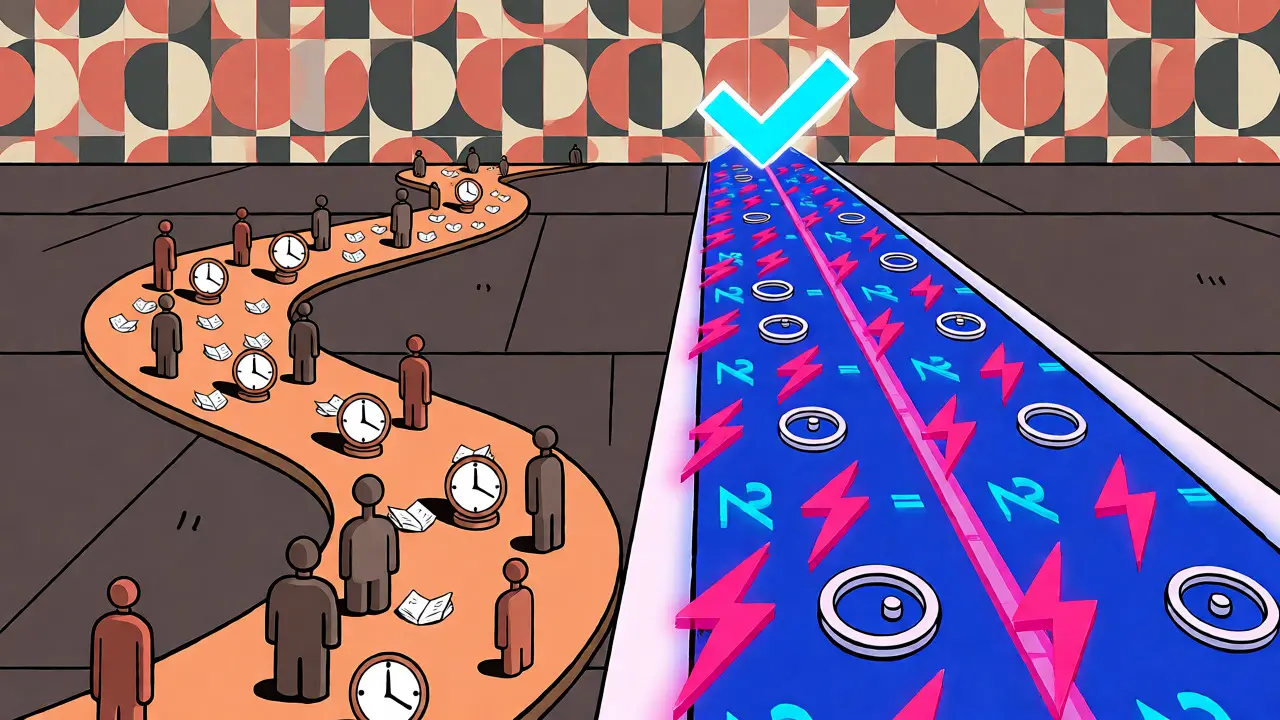
If you’re moving funds from Ethereum to a Layer 2, speed matters. With optimistic rollups, if you want to withdraw your ETH back to Layer 1, you might wait seven days. Why? Because the network waits for potential fraud proofs. With ZK-rollups, the proof is submitted immediately. Once Ethereum verifies it, your withdrawal is final. This reduces the window of uncertainty and improves the user experience.
However, ZK-rollups face their own challenges. Generating proofs is hard. It requires sophisticated engineering and powerful hardware. This centralizes the proving infrastructure, at least for now. Also, making a ZK-rollup fully compatible with Ethereum Virtual Machine (EVM) code is difficult. Some projects, like Starknet, use a different language (Cairo) to optimize for proving, which means developers can’t just copy-paste Solidity contracts easily.
The Future of Scaling
We are currently in a transition period. Ethereum is doubling down on its "rollup-centric roadmap." The goal is for Ethereum to be the settlement layer, while multiple L2s handle execution. ZK-rollups are seen as the long-term winner because they offer stronger guarantees than optimistic systems. As proving costs drop and tools improve, we expect to see more decentralized provers and perhaps even recursive proofs, where one proof verifies another, allowing for massive scalability.
For now, if you are looking to scale Ethereum, ZK-rollups offer the best blend of security and speed. But always check the specific project’s status. Are they using SNARKs or STARKs? Is the sequencer decentralized? These details matter more than the buzzwords.
Are ZK-rollups completely anonymous?
No, not by default. Most public ZK-rollups publish transaction data to Ethereum for verification, meaning transactions are visible to anyone. Privacy features must be explicitly added through encryption or specialized circuit designs.
What is the difference between zk-SNARKs and zk-STARKs?
zk-SNARKs produce smaller proofs that are cheaper to verify but typically require a trusted setup ceremony. zk-STARKs do not require a trusted setup and are resistant to quantum computing attacks, but their proofs are larger and more expensive to verify on-chain.
Why are ZK-rollups faster to exit than optimistic rollups?
Optimistic rollups have a challenge period (often 7 days) to allow for fraud proofs. ZK-rollups submit a validity proof immediately. Once Ethereum verifies this proof, the state is final, allowing withdrawals in minutes or hours rather than days.
Is Ethereum responsible for storing all ZK-rollup data?
Yes, for true rollups. They post compressed transaction data to Ethereum to ensure data availability. Recent upgrades like EIP-4844 introduced 'blobs' which store this data temporarily and cheaply, reducing costs significantly compared to permanent calldata storage.
Can I run my own ZK-prover?
Technically yes, but it is resource-intensive. Proving requires significant CPU/GPU power and memory. Currently, most networks rely on centralized or semi-centralized proving services due to the high computational cost, though decentralization efforts are ongoing.