
Zero-Knowledge Proofs in Crypto: How ZK Technology Brings Privacy and Scalability to Blockchains
 Jan, 21 2026
Imagine sending money without anyone seeing how much you sent. Or proving you’re eligible for a loan without showing your bank statements. This isn’t science fiction-it’s what zero-knowledge proofs make possible on blockchains today.
What Exactly Are Zero-Knowledge Proofs?
Zero-knowledge proofs (ZKPs) let one person prove they know something-like a password, a secret, or a valid transaction-without revealing the thing itself. Think of it like proving you have the key to a locked room by walking through it in the dark, while someone else watches you come out the other side. They know you had the key. They don’t know what the key looks like. This solves a big problem in crypto. Blockchains like Ethereum are public ledgers. Every transaction is visible. That’s great for transparency, but terrible for privacy. If you’re paying rent, buying medicine, or transferring funds between companies, you don’t want the whole world watching your balance. ZKPs fix this. They let you prove a transaction is valid-without showing the sender, receiver, or amount. The math behind it is complex, but the outcome is simple: privacy on a public network.How ZKPs Make Blockchains Faster
Blockchains aren’t just private-they’re slow. Ethereum can only handle about 15 to 45 transactions per second. That’s fine for a few users, but not for millions. Enter zk-Rollups. zk-Rollups bundle hundreds of transactions off-chain. They don’t post each one to Ethereum. Instead, they create one tiny cryptographic proof-often just a few hundred bytes-that says, “These 500 transactions are valid.” That proof gets posted on-chain. Ethereum checks it in seconds. The result? Up to 2,000 transactions per second, with fees 90% lower than on Ethereum’s main layer. Compare that to optimistic rollups, which rely on a 7-day waiting period in case someone tries to cheat. zk-Rollups skip that. Proofs are mathematically guaranteed. If the proof checks out, the transaction is final. No waiting. No disputes. By the end of 2025, zk-Rollups handled $287 billion in transactions-23% of all Ethereum Layer 2 activity. That’s up from $12 billion in 2023. Polygon zkEVM, zkSync, and StarkNet now dominate this space.zk-SNARKs vs. zk-STARKs: Which One Wins?
Not all zero-knowledge proofs are the same. Two main types power today’s blockchains: zk-SNARKs and zk-STARKs. zk-SNARKs are smaller and faster. A typical proof is only 180 bytes. But they need a one-time “trusted setup”-a ceremony where keys are generated. If someone steals those keys, they could fake proofs and create fake tokens. That’s a big risk. Projects like Zcash and zkSync use zk-SNARKs, but they’ve hardened their setups over years. zk-STARKs don’t need trusted setups. They’re more secure in that sense. But their proofs are bigger-around 45KB-and take longer to verify. They’re also quantum-resistant, which matters for long-term security. StarkNet uses zk-STARKs. Newer systems like Halo 2 and Plonk are changing the game. They combine the best of both: no trusted setup, smaller proofs, and faster generation. Midnight Network and Polygon zkEVM now use these advanced versions.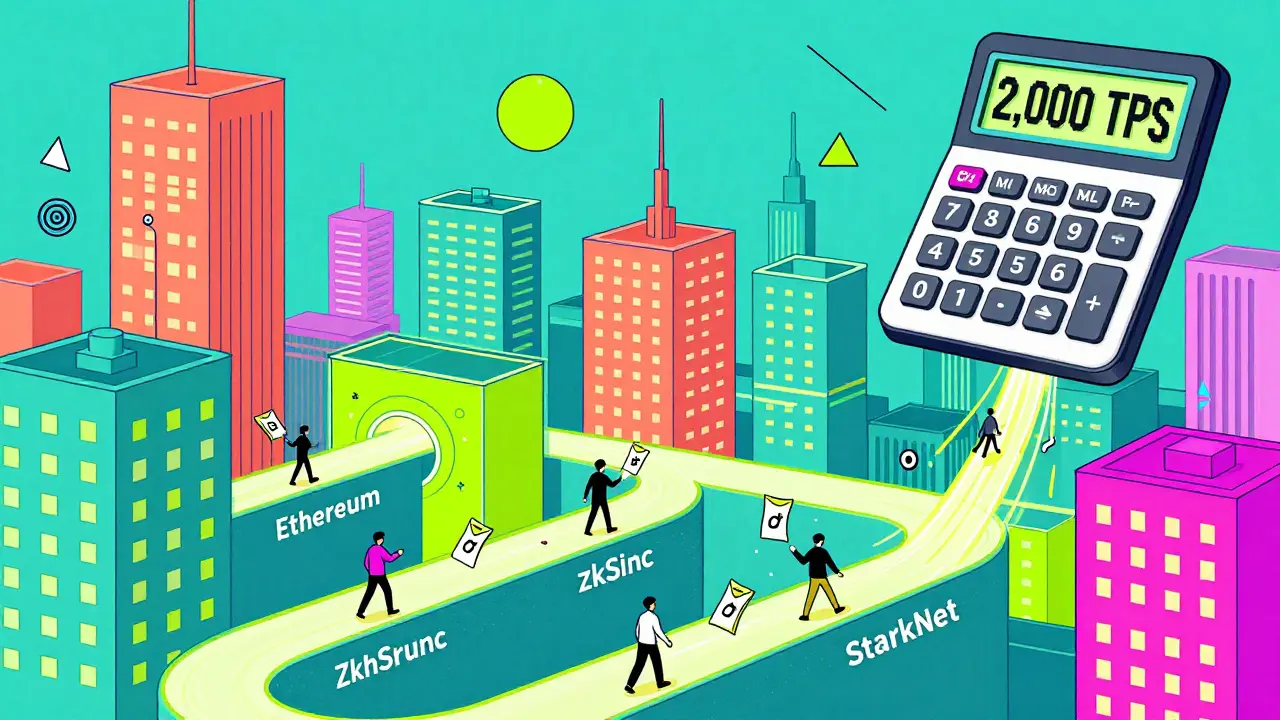
Real-World Use Cases Beyond Payments
ZKPs aren’t just for sending ETH. They’re being used in finance, supply chains, and even AI. JPMorgan uses ZKPs for interbank settlements. They prove a company has enough money to pay without revealing its full balance. That’s called a zero-knowledge range proof. It keeps data private but still meets regulators’ rules. Fortune 500 companies like Unilever and Walmart are testing ZKPs to track products without exposing supplier names or pricing. A shipment of coffee beans can be verified as organic and ethically sourced-without revealing where it came from or how much it cost. Even AI is getting in on it. Modulus Labs now builds ZK proofs to verify that a machine learning model made a correct prediction without showing the training data. That’s huge for healthcare and finance, where data privacy is locked down.The Downsides: Why ZKPs Aren’t Everywhere Yet
ZKPs are powerful, but they’re not easy. Generating a proof takes serious computing power. On a phone? Forget it. You need specialized hardware or cloud servers. Developers say writing ZK circuits-mathematical rules that define what’s being proven-is like building a bridge with only a hammer and a napkin. Languages like Cairo and Noir are hard to learn. One developer told me it took them eight months to build a simple ZK app. Debugging errors? Often takes days. Documentation is all over the place. Zcash’s guides are clear and detailed. StarkNet’s? Mixed reviews. GitHub issues from early 2025 show developers stuck on “non-deterministic circuit errors” and “gas estimation bugs.” Tools are improving, but the learning curve is steep. And then there’s cost. Verifying a ZK proof on Ethereum still costs 200,000 to 500,000 gas. That’s expensive. But Ethereum’s upcoming Prague hard fork in Q2 2026 will cut that by 90% with new precompiles. That’s a game-changer.
What’s Next for ZK Technology?
The future is ZK-native blockchains. Mina Protocol lets anyone verify the entire blockchain with just 22KB of data. That’s smaller than a tweet. You don’t need to download gigabytes of history. Just a tiny proof. zkEVMs are getting closer to full EVM compatibility. Polygon zkEVM reached 100% EVM equivalence in late 2025. That means any Ethereum smart contract can run on it with no changes. StarkNet’s Cairo 2.0, released in early 2026, now supports general-purpose code with 40% faster proof generation. Regulators are catching up too. The EU’s MiCA framework, active since January 2025, accepts ZK-proven compliance for financial reporting. The U.S. Treasury still worries about sanctions evasion-but that’s a policy problem, not a tech one. Gartner predicts 80% of enterprise blockchains will use ZK tech by 2028. Forrester says hardware acceleration will be needed for mobile adoption. Both agree: ZK isn’t a fad. It’s infrastructure.Should You Care?
If you use crypto, yes. ZKPs are quietly making your transactions cheaper, faster, and private. Wallets like Argent and Rabby now support zk-Rollups out of the box. You don’t need to understand the math. You just need to know your money moves faster and stays yours. If you’re a developer? Start learning Cairo or Noir. Join zkSync or StarkNet’s Discord. The tools are still rough, but the demand is exploding. Companies are hiring ZK engineers at 2x the salary of regular smart contract devs. And if you’re just watching? Keep an eye on Ethereum’s Prague upgrade. That’s when ZK tech stops being a niche feature and becomes the default way blockchains scale. Zero-knowledge proofs didn’t invent privacy. They made it work on public ledgers. That’s the real breakthrough.What is a zero-knowledge proof in simple terms?
A zero-knowledge proof lets you prove you know something-like a secret or a valid transaction-without revealing what that thing is. For example, you can prove you’re over 18 without showing your ID, or prove you have enough money to pay rent without showing your bank balance.
How do zk-Rollups improve blockchain scalability?
zk-Rollups bundle hundreds of transactions off-chain and generate one small cryptographic proof that all of them are valid. That proof is posted on the main blockchain (like Ethereum), which verifies it quickly. This reduces congestion, cuts fees by up to 90%, and boosts speed from 15 TPS to over 2,000 TPS.
Are zero-knowledge proofs secure?
Yes, if implemented correctly. zk-SNARKs require a trusted setup, which could be compromised if the keys are stolen. Newer systems like zk-STARKs and Halo 2 remove this risk by using math that doesn’t need trusted setup. Proofs are cryptographically verifiable, so fake transactions can’t be created without breaking the math.
Why aren’t all blockchains using ZKPs yet?
Generating ZK proofs is computationally heavy and requires specialized skills. Writing ZK circuits is hard, tools are still immature, and verification costs on Ethereum are high-though that’s changing with the Prague upgrade. Most projects are still in early adoption, and mobile devices can’t yet generate proofs efficiently.
What’s the difference between zk-SNARKs and zk-STARKs?
zk-SNARKs produce smaller proofs (180 bytes) but need a trusted setup. zk-STARKs don’t need trusted setup and are quantum-resistant, but their proofs are larger (45KB) and take longer to verify. zk-SNARKs are faster for everyday use; zk-STARKs are more secure long-term.
Can ZKPs be used for regulatory compliance?
Yes. Companies like JPMorgan use zero-knowledge range proofs to prove a transaction amount is within legal limits-say, under $10,000-without revealing the exact value. This satisfies anti-money laundering rules while protecting customer privacy. The EU’s MiCA framework now accepts this as valid compliance.
What’s the biggest challenge for ZK developers today?
Circuit optimization. Designing the mathematical rules (circuits) that define what’s being proven is the most time-consuming part. Developers spend an average of 112 hours per complex application just tuning the circuit to be efficient and error-free. Debugging tools are still limited, and languages like Cairo and Noir have steep learning curves.
Will ZKPs make crypto wallets more private?
Absolutely. Wallets like Argent and Rabby already let users send and receive tokens via zk-Rollups without exposing transaction amounts or balances. In the next two years, most major wallets will support ZK-based privacy by default, making your crypto activity truly private-even on public blockchains.