
ZK-EVM vs ZK-VM: Understanding the Compatibility and Performance Trade-Offs
 Jun, 19 2026
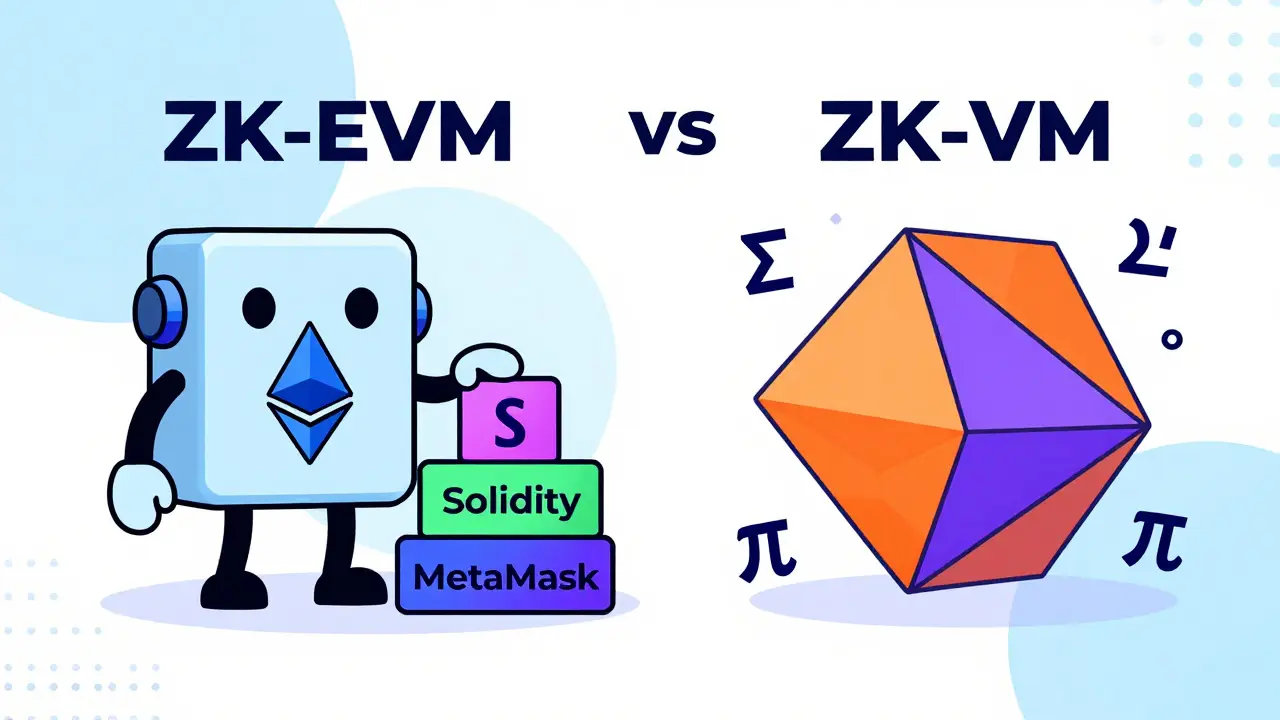
You want to build on a scalable blockchain. You’ve heard about zero-knowledge rollups. But now you’re stuck at the fork in the road: do you use a ZK-EVM is a zero-knowledge virtual machine designed to be compatible with Ethereum’s existing smart contract ecosystem, or do you go with a ZK-VM is a general-purpose zero-knowledge virtual machine optimized for proof generation speed and flexibility? This isn’t just a technical nitpick; it’s a decision that dictates your development timeline, your user experience, and your long-term costs.
The short answer? If you need to move an existing Ethereum dApp quickly without rewriting code, ZK-EVM is your friend. If you are building something new that demands maximum throughput, privacy, or complex off-chain computation, a ZK-VM might be the better engine. Let’s break down why these two technologies exist, how they differ under the hood, and which one actually fits your project.
What Is a ZK-EVM?
To understand the trade-off, we first need to look at what a ZK-EVM is trying to solve. The Ethereum Virtual Machine (EVM) is the runtime environment for executing smart contracts on the Ethereum blockchain has become the standard language of decentralized finance and NFTs. Thousands of developers know Solidity. Millions of users have MetaMask wallets configured for EVM-compatible chains.
A ZK-EVM takes this familiar environment and wraps it in zero-knowledge cryptography. It executes transactions off-chain, generates a mathematical proof that the execution was correct, and posts that proof to Ethereum Layer 1. The goal is simple: get the scalability of a Layer 2 while keeping the exact same developer experience as Layer 1.
Projects like Polygon zkEVM is a zero-knowledge rollup solution developed by Polygon Labs that aims to scale Ethereum while maintaining full compatibility with the Ethereum Virtual Machine, Scroll is a zkEVM-based Layer 2 scaling solution for Ethereum that focuses on achieving full bytecode equivalence with Ethereum mainnet, and zkSync Era is a Layer 2 scaling solution using zero-knowledge proofs that compiles Solidity code into a custom intermediate representation for efficient proving are leading this charge. They promise that you can take your Solidity contract, copy-paste it, and deploy it. No changes needed.
What Is a ZK-VM?
Now, let’s look at the other side of the coin. A ZK-VM is not born from the need to mimic Ethereum. It is born from the need to make zero-knowledge proofs fast and cheap. Systems like Risc Zero is a zero-knowledge virtual machine platform that allows developers to write programs in Rust and generate proofs for arbitrary computations and StarkNet is a permissionless decentralized ZK-Rollup operating as an L2 network over Ethereum, utilizing the STARK proof system and Cairo programming language (which uses the Cairo VM) are built from scratch with proving efficiency in mind.
These machines often run on instruction sets like RISC-V or custom architectures like Cairo. They don’t care about Ethereum opcodes. They care about arithmetic constraints. When you write code for a ZK-VM, you are usually writing in Rust, C++, or a specialized language like Cairo. The machine executes this code, generates a trace, and creates a proof that says, "I ran this program correctly."
This approach gives you incredible flexibility. You aren’t limited to smart contracts. You can prove anything: database queries, AI model inferences, or complex financial calculations. But there is a catch: you lose the instant familiarity of the Ethereum ecosystem.
The Vitalik Taxonomy: Measuring Compatibility
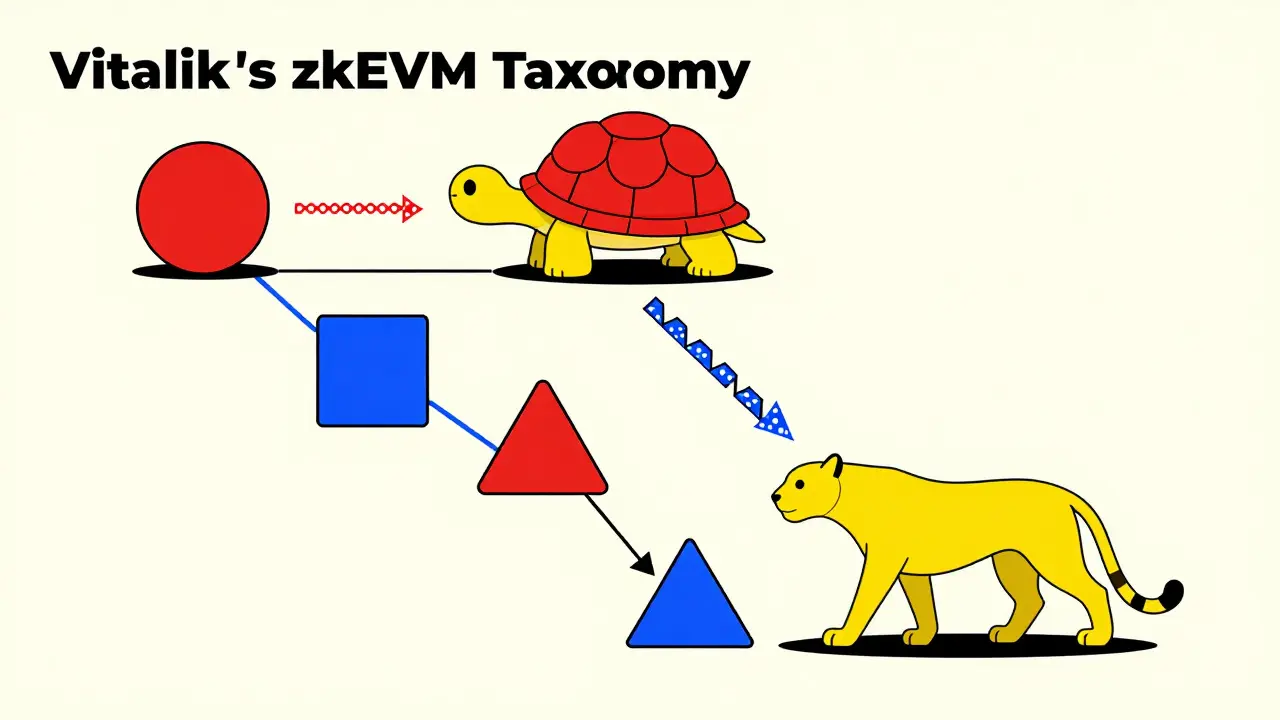
Not all ZK-EVMs are created equal. In August 2022, Vitalik Buterin published a taxonomy that helps us understand the spectrum of compatibility. This framework is crucial for making your decision because it quantifies exactly what you are sacrificing for performance.
| Type | Compatibility Level | Performance Impact | Example Projects |
|---|---|---|---|
| Type 1 | Fully Equivalent (Bytecode & Gas) | Lowest (Slowest Proving) | Research Prototypes |
| Type 2 / 2.5 | Bytecode Equivalent, Gas May Differ | Moderate | Polygon zkEVM, Scroll |
| Type 3 | Drops Rare Opcodes/Features | Higher | Some Early Testnets |
| Type 4 | Solidity Compatible, Not Bytecode | Highest (Fastest Proving) | zkSync Era (Early Versions) |
Type 1 zkEVMs try to replicate Ethereum perfectly, including every weird edge case and gas refund rule. This makes them incredibly slow to prove because the circuits required to model the EVM are massive. Type 4 zkEVMs, on the other hand, compile high-level Solidity code into a custom format. They are much faster but might break if you rely on low-level assembly or specific bytecode behaviors.
Most production-ready ZK-EVMs today sit around Type 2 or 2.5. They keep the bytecode compatible so your contracts work, but they tweak gas costs or reimplement precompiles to make the math easier for the prover. This is the sweet spot for most Ethereum developers who want speed without rewriting their entire codebase.
Performance: The Circuit Complexity Problem
Here is where the rubber meets the road. Why are ZK-VMs generally faster than ZK-EVMs? It comes down to circuit complexity.
The EVM is old. It was designed in the early days of Ethereum, before zero-knowledge proofs were a mainstream concern. Its opcodes are irregular. Some operations are simple additions; others involve complex memory expansion and storage access. Modeling this irregularity in arithmetic circuits (like R1CS or PLONK) is expensive. Every opcode requires a specific set of constraints. When you batch thousands of transactions, the prover has to solve a massive mathematical puzzle for each one.
In contrast, ZK-VMs like Risc Zero use RISC-V, a reduced instruction set computer architecture. The instructions are uniform and simple. This regularity translates directly into fewer constraints per operation. Fewer constraints mean smaller proofs and faster generation times. According to benchmarks from 2023, ZK-VMs can process millions of constraints per second, whereas ZK-EVMs often struggle to clear batches of thousands of transactions in under a minute on high-end GPU clusters.
If your application involves heavy computation-like processing large datasets or running complex algorithms-a ZK-VM will likely give you better throughput and lower fees. If your application is a standard DeFi swap or NFT mint, the performance difference might be negligible enough that the convenience of ZK-EVM wins out.
Developer Experience: Learning Curves and Tooling
Let’s talk about your team. What do they know? If your engineers are Solidity experts who live and breathe Hardhat and Foundry, moving to a ZK-EVM is a breeze. You can deploy your contracts in days. Audits remain valid. Users can connect their MetaMask wallets immediately. There is no friction.
Move to a ZK-VM, and the story changes. To use StarkNet, you need to learn Cairo. To use Risc Zero, you need to be comfortable with Rust and the concept of host-guest separation. This isn’t just a syntax change; it’s a paradigm shift. Debugging a ZK-VM program requires different tools. Testing frameworks are less mature. You might spend weeks or months ramping up your team instead of shipping product.
However, this steep learning curve buys you power. With Rust on Risc Zero, you can leverage a vast ecosystem of libraries for cryptography, data structures, and systems programming that simply don’t exist in Solidity. You are no longer constrained by the limitations of the EVM. You can build verifiable oracles, private voting systems, or cross-chain bridges with a level of sophistication that ZK-EVMs currently struggle to match efficiently.
Security and Standardization Risks
Security is paramount in crypto. Both approaches have risks, but they are different kinds of risks.
For ZK-EVMs, the primary risk is semantic divergence. If your Type 2.5 zkEVM handles a rare opcode differently than Ethereum mainnet, could a bug allow someone to exploit your L2 in a way that wouldn’t work on L1? Teams like Polygon and Scroll invest heavily in formal verification and reference tests to ensure their circuits match Ethereum’s behavior. However, the complexity of these circuits means bugs can hide in obscure corners. Additionally, many ZK-EVMs currently rely on centralized provers, creating a single point of failure until decentralized proving networks mature.
For ZK-VMs, the risk lies in the novelty of the stack. Cairo and RISC-V based ZK environments are newer. There are fewer auditors who specialize in these languages. A bug in your Cairo compiler or your Risc Zero guest program could lead to invalid proofs or lost funds. Furthermore, because ZK-VMs are not tied to Ethereum’s semantics, you must trust the correctness of the VM specification itself. If the underlying mathematical assumptions of the STARK or SNARK system are flawed, your security crumbles.
That said, ZK-VMs avoid the "edge case" hell of the EVM. By designing a clean, simple instruction set, projects like StarkWare reduce the attack surface related to legacy quirks like `SELFDESTRUCT` or unpredictable gas refunds.
Which One Should You Choose?
So, how do you decide? Here is a practical heuristic:
- Choose ZK-EVM if: You are migrating an existing Ethereum dApp. Your priority is user adoption and developer familiarity. You need MetaMask compatibility out of the box. Your workload consists of standard smart contract interactions (swaps, mints, governance).
- Choose ZK-VM if: You are building a new application from scratch. You require high-throughput computation or privacy features. Your team is proficient in Rust or willing to learn Cairo. You are building infrastructure like oracles, identity systems, or cross-chain bridges where EVM compatibility is irrelevant.
The landscape is evolving. We are seeing convergence. ZK-EVMs are adopting techniques from ZK-VMs to improve performance. ZK-VMs are building compatibility layers to interact with Ethereum. In the next few years, you might see hybrid solutions where a ZK-EVM offloads heavy computation to a ZK-VM backend.
For now, the choice remains clear: compatibility versus performance. Know your constraints, know your team, and choose the tool that aligns with your immediate goals.
Can I use Solidity on a ZK-VM like StarkNet?
Not directly. StarkNet uses the Cairo programming language. While there are transpilers and compatibility layers being developed, you cannot simply deploy raw Solidity bytecode to StarkNet. You would need to rewrite your contracts in Cairo or use a high-level abstraction that compiles to Cairo.
Are ZK-EVMs slower than Optimistic Rollups?
In terms of finality, ZK-EVMs are faster because they provide cryptographic validity proofs immediately, whereas Optimistic Rollups have a 7-day fraud proof window. However, in terms of transaction throughput and proof generation time, ZK-EVMs can be bottlenecked by the complexity of proving EVM execution, making them potentially slower to process batches than highly optimized ZK-VMs or simpler circuits.
What is the hardware requirement for running a ZK-EVM prover?
Running a ZK-EVM prover typically requires significant computational resources. Most operators use high-end GPUs (like NVIDIA A100s) or FPGAs to generate proofs efficiently. A single server with 64GB+ RAM and multiple GPUs is common for handling batches of thousands of transactions. This is more demanding than running a standard Ethereum node.
Is Risc Zero compatible with Ethereum wallets?
Risc Zero itself is a general-purpose proving platform, not a blockchain. Therefore, it does not have its own wallet ecosystem. However, applications built on Risc Zero can verify proofs on Ethereum, allowing users to interact with those applications using standard Ethereum wallets like MetaMask. The wallet interacts with the verifier contract on L1, not directly with the Risc Zero VM.
Will ZK-EVMs eventually replace ZK-VMs?
Unlikely. They serve different purposes. ZK-EVMs are optimized for Ethereum compatibility and mass adoption of existing dApps. ZK-VMs are optimized for general-purpose verifiable computation, privacy, and high-performance tasks. The future likely involves interoperability between both, rather than one replacing the other.