
Sidechains Explained: How Independent Blockchains Boost Mainnet Scalability
 Feb, 24 2026
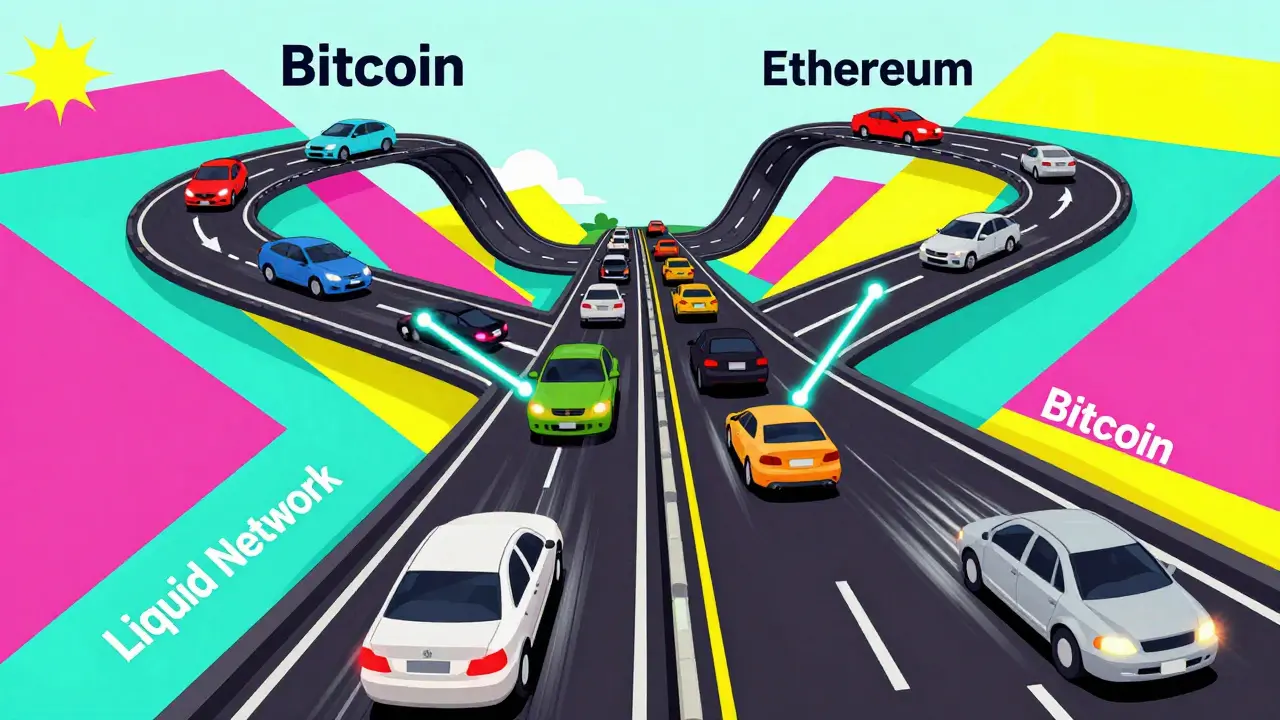
Imagine a highway that’s always jammed. Every car, every truck, every delivery van has to squeeze through the same narrow lanes. Now imagine building parallel roads that connect to the main highway - roads designed for speed, for trucks, for bikes, for deliveries that don’t need to slow down the main road. That’s what sidechains do for blockchains.
What Exactly Are Sidechains?
A sidechain is a sidechain is a separate blockchain that runs parallel to a main blockchain, like Bitcoin or Ethereum, and allows assets to move back and forth between them. It’s not a tweak or an upgrade to the main chain. It’s its own full blockchain with its own rules, its own validators, and its own speed. But it’s not isolated. It’s linked.
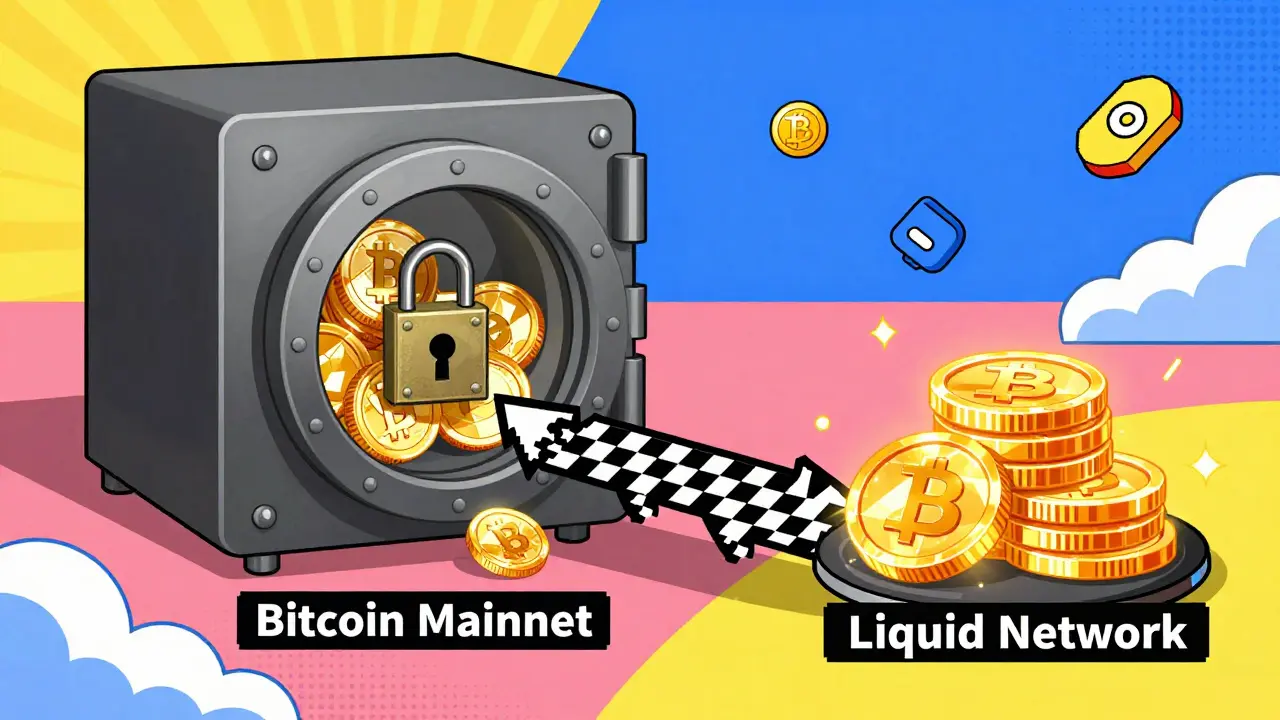
The connection isn’t just a fancy API call. It’s a two-way peg is a mechanism that locks assets on the main chain and issues equivalent assets on the sidechain, and vice versa. When you send Bitcoin to a sidechain, those coins get locked in a digital vault on the Bitcoin network. In return, an equal amount of "wrapped" Bitcoin appears on the sidechain. When you want your Bitcoin back, you burn the sidechain version, and the original coins are unlocked. This keeps the total supply balanced and prevents inflation.
Why Do Sidechains Matter?
The main chain - whether it’s Bitcoin or Ethereum - was never built to handle millions of transactions per second. Bitcoin confirms about 7 transactions per second. Ethereum handles around 15. That’s fine for digital gold or simple transfers, but not for gaming, payments, or real-time trading.
Sidechains solve this by taking the load off. Instead of every transaction clogging up the main chain, thousands can happen on a sidechain. Think of it like using a local grocery store instead of driving to a warehouse 50 miles away. You get what you need faster, cheaper, and without slowing down the highway.
Some sidechains are built for speed. Others are built for privacy. Some let you run smart contracts that the main chain doesn’t support. For example, Bitcoin has no native smart contract system. But a sidechain like Liquid Network is a Bitcoin sidechain developed by Blockstream that enables faster, confidential Bitcoin transactions and token issuance lets you issue tokens, trade them in seconds, and even settle institutional trades - all without touching Bitcoin’s main chain.
How Do Sidechains Stay Secure?
Here’s the big question: If a sidechain is independent, how do we know it’s not getting hacked? What if someone creates a fake sidechain and steals all the locked Bitcoin?
Security doesn’t come from the main chain. It comes from the sidechain’s own validators. Sidechains have their own set of nodes - often a smaller, more specialized group - that confirm blocks and enforce rules. These nodes are incentivized to behave honestly. If they try to cheat, they lose their staked tokens or their reputation.
The two-way peg also adds a layer of protection. The main chain doesn’t need to constantly monitor the sidechain. Instead, the sidechain monitors the main chain. When a user wants to move assets back, the sidechain submits a proof - like a Merkle proof of a transaction - that the main chain can verify. This one-way dependency reduces the load on the main chain and keeps it simple.
It’s not perfect. If a sidechain’s validators are compromised, assets on that sidechain could be at risk. That’s why not all sidechains are created equal. Some use federated models - where a small group of trusted parties validate transfers. Others use decentralized proof-of-stake or proof-of-authority. The more decentralized the sidechain, the more secure it tends to be.
Sidechains vs. Other Layer 2 Solutions
There are other ways to scale blockchains - like rollups, state channels, and plasma chains. But sidechains are different.
- Rollups bundle many transactions into one and post them to the main chain. They inherit the main chain’s security but still rely on it for finality.
- State channels let users transact privately off-chain and only settle on-chain when done. Great for micropayments, but not for complex apps.
- Sidechains are full blockchains. They don’t need to post data back to the main chain constantly. They can have their own consensus, their own block times, even their own native tokens.
That freedom is both a strength and a risk. Sidechains can innovate faster. But they also carry more risk. If a sidechain fails, the main chain doesn’t care. It just keeps running.
Real-World Examples
One of the oldest and most used sidechains is Liquid Network is a Bitcoin sidechain launched in 2018 that enables faster and confidential Bitcoin transactions. It’s used by exchanges like Bitfinex and Kraken to settle large Bitcoin trades in under two minutes - instead of the 10+ minutes it takes on Bitcoin’s main chain.
On Ethereum, Polygon PoS is a Layer 2 blockchain that uses a PoS consensus to scale Ethereum with lower fees and faster transactions started as a sidechain. It connects to Ethereum via a bridge and lets developers deploy dApps with near-instant finality and gas fees under a penny.
Even non-crypto companies are experimenting. In 2025, a major European bank piloted a sidechain to settle cross-border corporate payments in under 10 seconds using a private blockchain linked to the euro’s digital ledger.

When Sidechains Don’t Work
Sidechains aren’t magic. They have limits.
First, they require trust. If the sidechain’s validators are centralized - say, controlled by one company - then you’re not really getting decentralization. You’re just moving the bottleneck.
Second, liquidity matters. If no one is using your sidechain, there’s no point in using it. A sidechain needs users, developers, and incentives to thrive. Many sidechains die because they’re built for a use case that never catches on.
Third, interoperability is still messy. Moving assets between sidechains isn’t always smooth. You might need to go back to the main chain first. Cross-chain bridges are still a weak spot in the ecosystem.
What’s Next for Sidechains?
By 2026, sidechains are no longer experimental. They’re infrastructure.
More blockchains are building native sidechain support. Ethereum’s upcoming upgrades include better tooling for deploying and managing sidechains. Bitcoin developers are working on improved two-way pegs that reduce reliance on trusted validators.
The real shift? Sidechains are becoming app-specific. Instead of one sidechain for everything, we’re seeing sidechains built for:
- High-frequency trading (sub-second settlement)
- Privacy-preserving identity verification
- Regulatory-compliant asset tokenization
- IoT device micropayments
This is the future: a web of blockchains, each optimized for a job. The main chain holds the gold. The sidechains do the heavy lifting.
Are sidechains safer than the main chain?
No. Sidechains have their own security model and are not as secure as the main chain. Bitcoin and Ethereum have thousands of nodes securing them. Sidechains often rely on dozens or hundreds. If a sidechain’s validators are compromised, funds on that chain can be stolen. Always check how decentralized and audited a sidechain is before using it.
Can I use sidechains without owning Bitcoin or Ethereum?
Yes. Many sidechains have their own native tokens and can operate independently. For example, Polygon PoS has its own MATIC token. You can use apps on these sidechains without touching the main chain. But if you want to move assets from Bitcoin or Ethereum, you’ll need to hold some of the original currency to lock it in.
Do sidechains have their own cryptocurrencies?
Many do. Sidechains often create their own tokens to pay for gas, reward validators, or govern the network. These tokens are separate from the main chain’s currency. For example, Liquid Network uses L-BTC (pegged Bitcoin) and a governance token called L-BTC. Polygon uses MATIC. But some sidechains, like those built for enterprise use, may not have tokens at all.
Can sidechains be shut down?
Yes. If the team behind a sidechain stops maintaining it, or if the validators stop confirming blocks, the sidechain can freeze. Users may still be able to withdraw assets back to the main chain if the two-way peg is still functional. But if the bridge is broken and no one is running nodes, funds could be locked indefinitely.
Are sidechains the future of blockchain scaling?
They’re part of it. Sidechains offer unmatched flexibility for specialized applications. But they’re not the only solution. Rollups are gaining ground for Ethereum because they’re more secure. The future likely involves a mix: rollups for security-critical apps, sidechains for high-speed or custom logic, and the main chain as the anchor.