
NPS Contribution: How Employer and Personal Contributions Build Your Retirement
When you hear NPS contribution, the National Pension System is India’s government-backed retirement savings scheme that lets you build a pension through regular contributions. Also known as National Pension System, it’s not just another investment—it’s a structured way to fund your life after work, with tax benefits and employer support built in. Whether you’re saving on your own or your company chips in, every rupee you put into NPS grows over time, and the government even adds a small bonus under certain conditions.
One of the biggest advantages of NPS contribution is how Corporate NPS, when your employer matches your contributions as part of your salary package. Also known as employer-assisted retirement plan, it’s essentially free money going into your retirement account. For example, if you contribute ₹5,000 a month and your company matches it, you’re instantly doubling your savings without lifting a finger. That’s not a bonus—it’s a retirement accelerator. And unlike some other plans, NPS lets you choose how your money is invested—between government bonds, corporate debt, and even stocks—giving you control over risk and returns.
But NPS contribution isn’t just for people with corporate plans. Even if you’re self-employed or work for a small business, you can open your own NPS account and still get tax breaks under Section 80C and an extra ₹50,000 deduction under Section 80CCD(1B). That means you can reduce your taxable income by up to ₹2 lakh a year just by saving for retirement. And unlike fixed deposits or PPF, NPS offers market-linked returns, which means your money has a real shot at growing faster over 20–30 years.
What most people don’t realize is that NPS contribution doesn’t end when you retire. At 60, you must use at least 40% of your corpus to buy an annuity—a regular monthly payout for life. The rest? You can take as a lump sum, tax-free if you’ve contributed for at least 10 years. That’s a rare combo: tax savings now, tax-free cash later, and steady income in retirement. It’s not flashy, but it’s one of the most reliable ways to avoid running out of money when you stop working.
If you’re wondering how this fits with other tools like ELSS, PPF, or even home loan tax benefits, the answer is simple: NPS is the backbone. While ELSS gives you higher returns but locks money for 3 years, and PPF offers safety but lower growth, NPS sits in the middle—offering growth potential, employer help, and serious tax efficiency. It’s not about picking one over the other. It’s about stacking them right.
Below, you’ll find real guides that break down exactly how NPS contribution works in different situations—whether you’re an employee getting employer support, a freelancer building your own plan, or someone trying to understand why your salary slip shows a deduction labeled "NPS." These aren’t theory pieces. They’re practical, up-to-date, and focused on what actually moves the needle for your retirement savings.
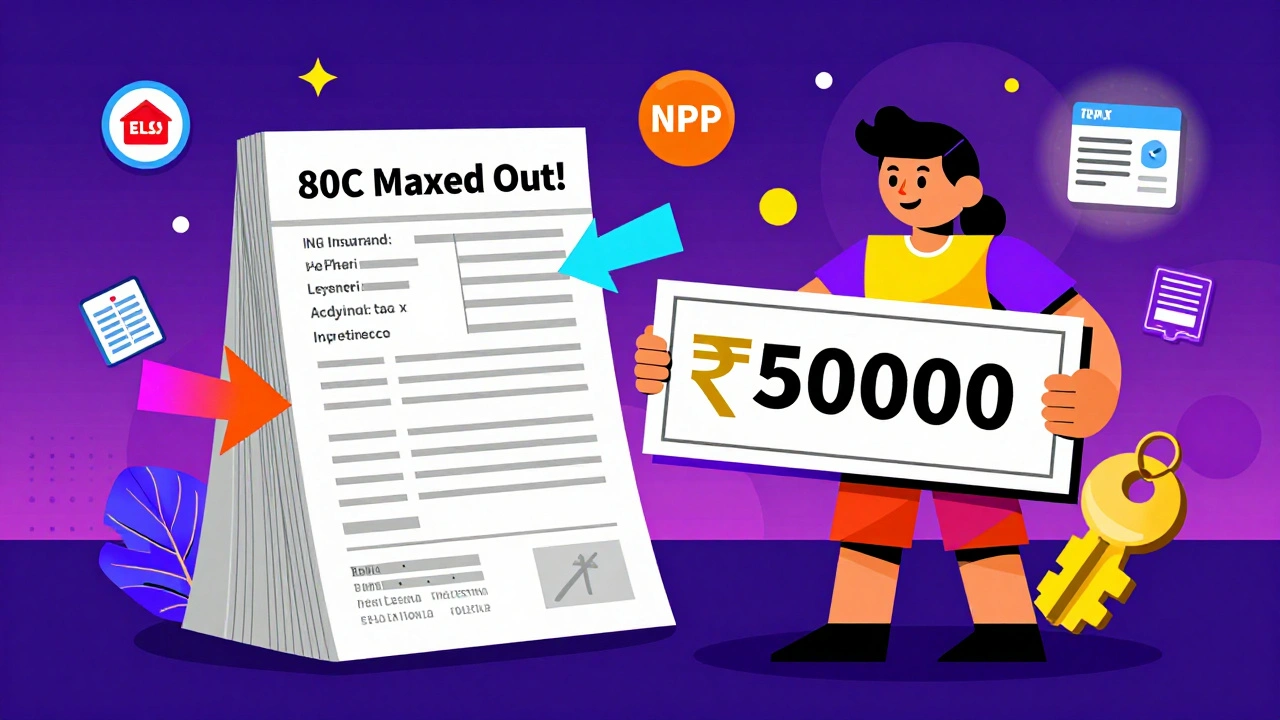
Section 80CCD(1B) in India: How to Claim an Extra ₹50,000 Deduction for NPS Contributions
Section 80CCD(1B) lets you claim an extra ₹50,000 tax deduction for NPS contributions, on top of the ₹1.5 lakh limit under 80C. Learn how to use it, who qualifies, and how much you can save.
Categories
- Cryptocurrency
- Careers & Education
- Home & Living
- Technology
- Home & Lifestyle
- hire domestic help in Mumbai
- hire drivers in mumbai
- Personal Finance
- hire pet care in mumbai
- Travel & Transportation